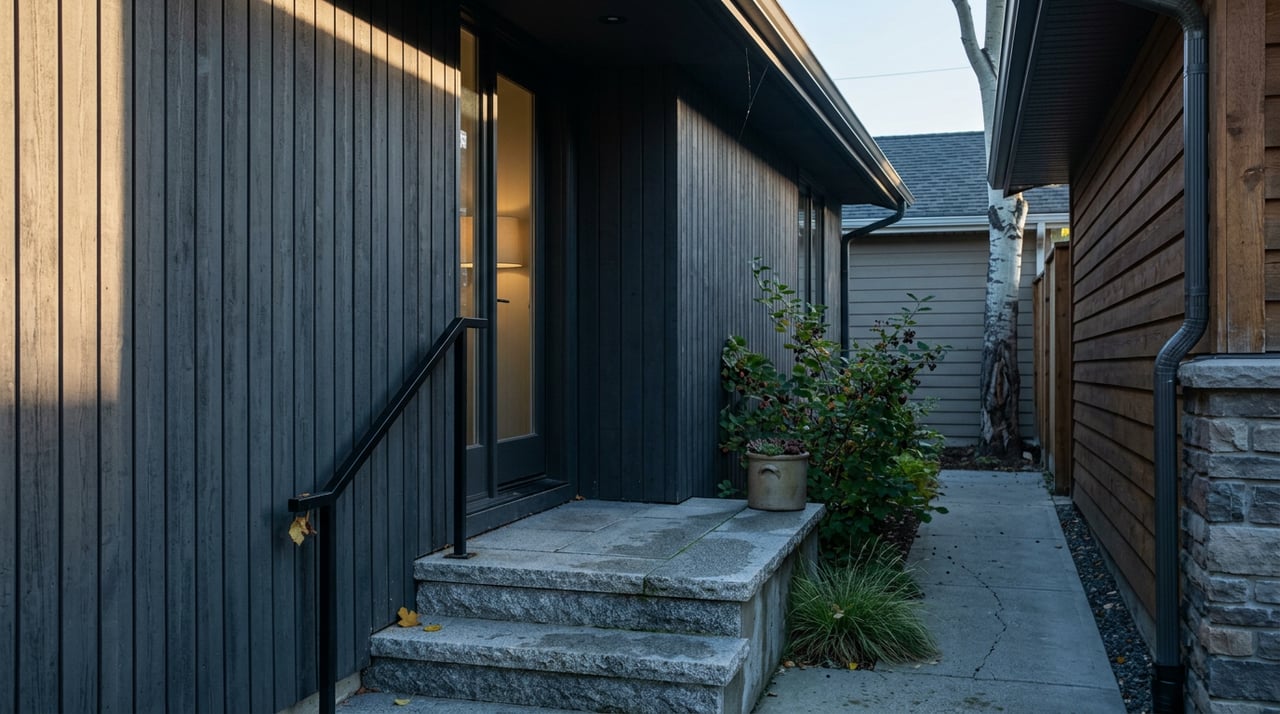
Walk to the north end of Aspen Street on any weekday morning and count the cars parked along the curb. There won't be many. Not because nobody uses the trail that starts there. Because nobody can park at the trail that starts there.
The Jud Wiebe Trailhead sits right where Aspen Street runs out of pavement, a few residential blocks up from Sunnyside. There is no lot, no gravel pull-off, no painted spaces. Anyone arriving by car has to find street parking a few blocks down and walk up, and depending on the morning, that parking may not exist on Aspen Street at all. The trailhead sits at the edge of a residential neighborhood.
A Neighborhood Defined by a Few Blocks, Not a View
Sunnyside sits on the east side of downtown Telluride, and its name is literal: the slope catches sun exposure that the shadier west side of the box canyon doesn't get in winter. But the more useful fact for anyone who actually lives there is proximity, not light. Homes on North Fir Street and nearby blocks routinely run just two to four minutes on foot to Colorado Avenue, Telluride's main commercial strip. That is a genuinely short walk, closer to a hallway than a commute, and it means Sunnyside functions less like a separate neighborhood and more like the quiet end of the same street the whole town shares.
That closeness is also what makes the trailhead question interesting. The trailhead has no dedicated parking, so visitors arriving by car need to find street parking and walk up. Hiking guides describe the Wiebe as a must-do.
The Trail With No Front Door
The Jud Wiebe Trail is named for a U.S. Forest Service snow ranger who designed and began building it before he died in 1986. Volunteers and the Forest Service finished the loop the following year. It starts at the end of Aspen Street, crosses a timber bridge over Cornet Creek early in the climb, and rises from roughly 8,900 feet to just under 10,000 feet before looping back down past Liberty Bell Flats and Tomboy Road. Sources differ slightly on the exact numbers, some log it at 3.1 miles with about 1,100 feet of gain, AllTrails puts it at 3.5 miles with 1,233 feet, but every account agrees on the shape of the experience: a short, steep climb that rewards you with views of Ajax Peak, Bear Creek Canyon, and the ski runs on Telluride's north-facing slopes, with glimpses of Bridal Veil Falls from the higher benches.
A guide on Telluride.net describes the crowd on the Wiebe: "You'll also see dogs, and occasionally a mountain biker. Even so, the Wiebe is rather quiet." That is a striking description of a trail that ranks among the most reviewed hikes in the region.
For Sunnyside residents, the trailhead is within walking distance from nearby streets. Visitors arriving by car need to find street parking and walk up.
What That Means on an Ordinary Week
Here's the part that's easy to miss if you don't live nearby: this same walkability cuts the other way in August. Telluride's summer calendar stacks major events into Town Park, which sits close enough to Sunnyside that residents may notice them in noise and foot traffic, even without getting in a car.
The Telluride Jazz Festival ran August 7 through 9 this year. In December 2025, Town Council approved a capacity increase for the festival from 2,999 to 6,000 attendees per day, reclassifying it from a "medium" festival to a "major" one under the town's event code. That same December meeting also cleared a new Planet Bluegrass concert for Town Park on August 28 and 29, with a daily cap of up to 9,000 people, deliberately scheduled in the open weekend between the Telluride Mountain Run on August 22 and the Telluride Film Festival, which opens September 3.
For a Sunnyside household, that's not an abstraction. The same walkable geography that makes the neighborhood pleasant most of the year also means amplified music carrying up the hillside during Town Park events. The location brings different experiences: nearby residents can walk to the trailhead, while events can bring music and foot traffic to the area.
Two Blocks, Two Eras of Telluride Dining
The same short walk down to Colorado Avenue that gets you a coffee also puts you in the middle of a stretch of restaurants spanning more than a century of the same buildings changing hands. The Telluride National Club building, 120 years old, has hosted a rotating cast of restaurants over the decades and now holds The National, a Mediterranean and Italian spot with shared plates and a ten-seat bar.
A few doors down at 100 W. Colorado Avenue is The Grand, opened by chefs Erich Owen and Ross Martin, longtime friends who first worked together as cooks at Allred's before building a run of Telluride restaurants of their own: The National in 2018, Little House in 2020, which later became Petite Maison, and now The Grand. One of them summed up the decision to finally open a place fully on their own terms, after years of building other people's kitchens, in four words in the Telluride News: "under our own terms."
Walk the other direction on the same block and the newest names keep showing up. LIZ, run by chef Eliza Gavin, recently settled into a new spot serving what her own menu calls Creole heat with French discipline. The New Tunnel Supper Club runs a single nightly seating behind Clark's Market with a menu that rotates every five weeks. None of this requires a car, a rideshare, or even much of a walk. It requires living on the sunny side of a two-block stretch that happens to hold both Telluride's oldest surviving restaurant building and this year's newest openings.
Sunnyside's Compact Geography
Sunnyside's appeal is its compact geography: the Jud Wiebe Trailhead, restaurants along Colorado Avenue, and Town Park events are all within a few blocks. Nearby residents can walk to the trailhead, while visitors arriving by car need to find street parking and walk.
If you're weighing whether that compact geography fits the way you want to live day to day, that's exactly the kind of on-the-ground read Hilbert Homes spends its time on. Reach out for a personal consultation and a free home valuation, and we'll walk you through what a given block of Sunnyside, or any corner of Telluride, actually feels like to live in before you decide it's the one.